A Recap of the Life Science CXO Conclave 2026
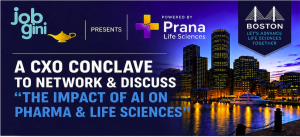
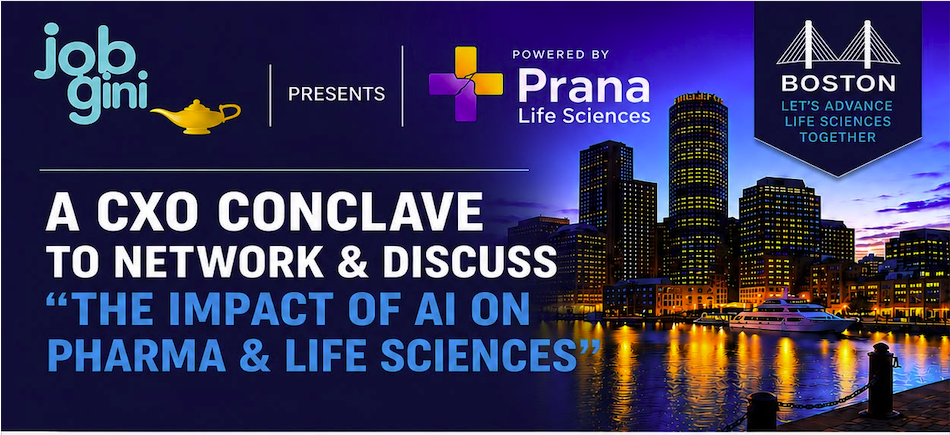
On September 10, the Life Science CXO Conclave brought together nearly 90 senior leaders in Burlington, Massachusetts for an evening focused on one question: how is artificial intelligence actually changing pharma and life sciences — not in theory, but in practice?
Hosted by Prana Life Sciences and JobGini, the invite-only forum drew CXOs, founders, and innovators from medical device, biotech, pharma, technology, and healthcare organizations, alongside voices from academia. It was, by every measure, a room built for candid conversation rather than sales pitches.
“This conclave definitely was a very successful program,” said Giri Masireddy, CEO of Prana Life Sciences. “We had CXO leaders who are entrepreneurs, and also very senior executives from bigger organizations, all in the same room talking honestly about where AI is actually moving the needle in life sciences.”
Drug Discovery: Capability Is Surging, Clinical Impact Isn’t — Yet
Dr. Prakash Raman, CEO of InduPro Therapeutics, opened the speaker sessions with a clear-eyed look at AI in drug discovery. His core message: the technology is advancing quickly, but most of that effort is aimed at the wrong stage of the pipeline. Tools like AlphaFold and generative chemistry models have made hit-finding faster, but the real bottleneck — Phase II efficacy — is where AI is least applied today.
Raman laid out three structural reasons AI has struggled to translate into approvals: biological data is conditional and context-dependent, chemical space is vast and poorly sampled by existing datasets, and strong model performance on a benchmark doesn’t guarantee it answers the real drug-discovery decision. His path forward: target clinical impact and patient stratification directly, and generate data designed to validate real decisions — not just to feed the next model.
Protecting Scientific Time
Gary Kaufman, co-founder of ABI-LAB, brought a different lens: infrastructure. Drawing on over a decade of experience supporting emerging life sciences companies — tenants that have collectively raised more than $5 billion and brought FDA-approved therapies to patients — Kaufman framed AI and automation as tools that give researchers their time back. His five ways AI protects the work in the lab: environmental monitoring, predictive maintenance, intelligent power management, active redundancy, and capacity planning. His closing line captured the spirit of the talk: “Science moves forward when brilliant people have time to think.”
AI in Quality: Faster, Not Looser
Dr. Yusef Yacouba-Issa, a veteran Quality Assurance leader across companies including Bristol Myers Squibb, Bluebird bio, and Roivant Sciences, delivered one of the evening’s sharpest messages: AI is an enabler, not a decision-maker. His talk on AI-enabled Quality Assurance made the case that AI should take over repetitive document review and flag exceptions and risk — but the qualified QA reviewer must always make the final call. “Let AI find the exception. Let QA make the decision,” he said, framing this as the operating model that lets pharma capture AI’s speed without compromising GxP, data integrity, or patient safety.
The Panel: From AI-Assisted to AI-Native
The evening closed with a panel discussion, “From AI-Assisted to AI-Native Pharma Industry,” moderated by Chandra Ramanathan, Executive Vice President at BRC Therapeutics and Executive Chair of Nucleate. Joining him were Dr. Meena Subramanyam (Vice President and Global Program Leader, Takeda Pharmaceuticals), Kailash Swarna (who leads Accenture’s Research & Early Development practice for Life Sciences), Kajal Anandani (Founder and CEO, K3 Innovations), and Ravi Kaushik (Founder and CEO, ROPHAI).
The conversation ranged widely — from how large organizations like Takeda and Accenture are operationalizing AI, to how smaller, founder-led companies are building AI-native from day one. Attendees consistently pointed to the panel’s candor and range of perspective as one of the evening’s highlights.
A Room Built for Connection
Beyond the stage, the Conclave’s real value was in the room itself: CXOs and founders trading notes with peers from Takeda, Accenture, and beyond, alongside academic voices from institutions including MIT and Harvard. Sonal Bhandary, Head of IT at Collegium Pharmaceutical, kept the evening moving as emcee, and JobGini’s Gunjan Kuthiala helped bring the leadership community together in the first place.
“The entire topic was exploring how AI is being used in life sciences and pharma,” Masireddy noted, “and having that level of experienced, repeat industry leadership in one room is what made it work.”
Prana Life Sciences and JobGini thank every speaker, panelist, and attendee who made the evening a success — and look forward to continuing the conversation at future events.