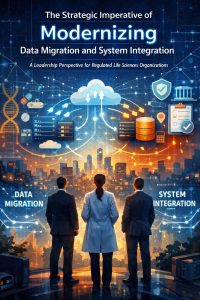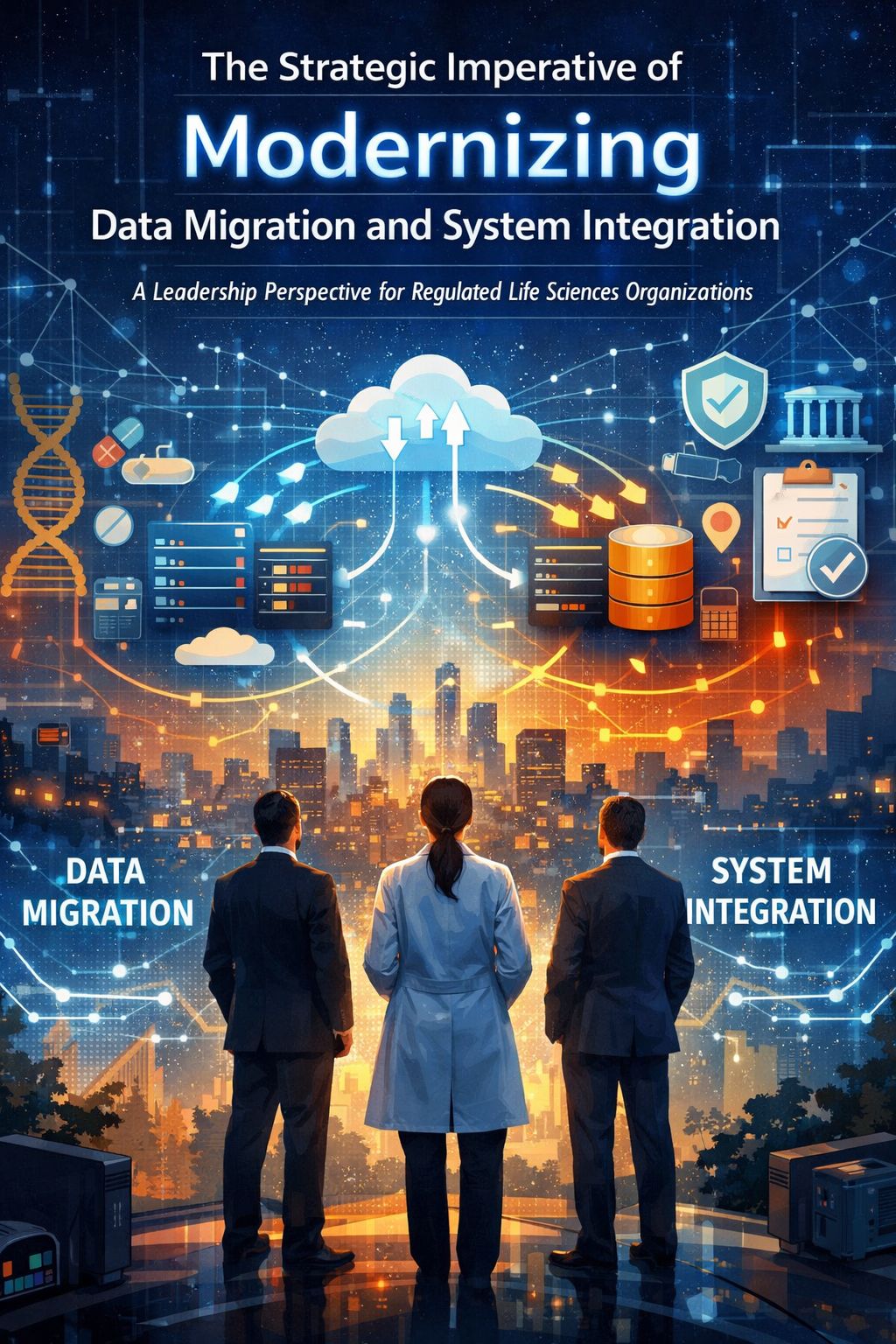
The Strategic Imperative of Modernizing Data Migration and System Integration
A leadership perspective for regulated life sciences organizations
For life sciences executives, the pressure to modernize is no longer a future consideration — it is a present-day business imperative. The organizations best positioned to lead in clinical development, quality management, and commercial execution over the next decade are those making deliberate, governance-driven investments in their technology infrastructure today.
Yet modernization in a regulated environment is fundamentally different from modernization elsewhere. It demands more than technical ambition. It demands strategic discipline.
Two activities sit at the heart of nearly every digital transformation initiative in life sciences: data migration and system integration. How an organization approaches these two activities will determine not only whether its modernization succeeds — but whether it strengthens or weakens its standing with regulators, partners, and patients.
The Hidden Cost of Doing Nothing
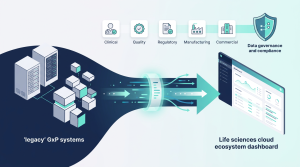
Many life sciences organizations continue to operate technology landscapes built across decades of incremental decisions. Legacy GxP systems support critical processes — clinical data management, pharmacovigilance, manufacturing quality, regulatory submissions — but increasingly at a cost that is difficult to justify and harder to sustain.
The risks are compounded and real: aging infrastructure that strains IT resources, fragmented data silos that impede decision-making, limited interoperability that forces manual workarounds, and operational processes that quietly accumulate compliance risk with every workaround and exception.
The instinct to preserve the status quo is understandable. Legacy systems carry years of validated history, and the perceived risk of change feels high. But the true risk calculation must account for what inaction costs: slower drug development cycles, audit exposure from brittle data practices, and a widening competitive gap with organizations that have already modernized.
The question for leadership is not whether to modernize — it is how to do so without compromising the compliance integrity that has been built over years.
Data Migration as a Strategic Event, Not a Technical Task
Data migration is routinely underestimated. It is scoped as a technical workstream, staffed with project resources, and treated as a one-time activity. Organizations that approach it this way frequently discover — too late — that migrating regulated data is among the most consequential events in a transformation program.
In regulated environments, every historical GxP record carries regulatory weight. Audit trails, metadata, and data relationships are not artifacts of legacy system architecture — they are evidence. Regulators expect that evidence to remain intact, traceable, and accessible, regardless of how many systems it has passed through.
Organizations that lead in this space approach migration as a governance event first, and a technical event second. That means making deliberate decisions early — before a single record moves — about four foundational questions:
- Which data carries regulatory obligation and which can be archived or retired?
- How will data quality issues in legacy systems be resolved without compromising historical integrity?
- What does success look like, and how will it be verified and documented?
- How will the migration process itself be validated — not just the migrated output?
Organizations that answer these questions before mobilizing technical teams consistently achieve better outcomes: fewer regulatory findings, stronger audit defensibility, and migrations that conclude on schedule with documented evidence of data integrity throughout.
Prana Life Sciences works with life sciences organizations to design and execute migration strategies that are structured, validated, and built to withstand regulatory scrutiny. Our approach treats data integrity not as a constraint on migration design — but as its foundation.
System Integration: Where Visibility Becomes Competitive Advantage
Modern life sciences operations do not run on single systems. Clinical trial platforms, quality management systems, regulatory information management tools, manufacturing execution systems, and commercial applications must increasingly operate as a connected ecosystem — exchanging data in real time to support faster decisions and stronger oversight.
For executives, integrated systems are not primarily a technology story. They are an operational visibility story. An organization that can see, in one place, the relationship between clinical outcomes, quality signals, and regulatory timelines has a structural advantage over one that cannot.
But integration in a regulated environment introduces governance obligations that must be addressed at the strategic level, not delegated away. When systems exchange data, questions of accountability become complex:
- Which system owns a given record, and who is responsible for its accuracy?
- What controls govern how data is transformed as it moves across system boundaries?
- How are integration failures detected, logged, and resolved?
- What evidence demonstrates that integrated systems behave reliably under real-world conditions?
These are not IT questions. They are quality and compliance questions with IT dimensions. Organizations that conflate the two — that treat integration as a purely technical deployment — frequently find themselves revisiting architecture decisions under pressure from a regulatory inspection or audit finding.
Leading organizations build integration governance into the design phase. They define system ownership boundaries before interfaces are built, not after. They validate not just normal-state data flows but error handling, exception management, and recovery scenarios. And they build monitoring into integrated environments so that data quality issues surface proactively rather than during an inspection.
Traceability Is Not a Deliverable — It Is a Culture
Across both migration and integration initiatives, the organizations that perform best in regulatory inspections share a common characteristic: they can tell the story of their data. They know where it originated, how it moved, who touched it, and where it lives today.
This is the operational definition of traceability — and it does not emerge from a documentation sprint at the end of a project. It is built into governance structures, data ownership models, metadata standards, and audit trail controls from the beginning of a modernization program.
For executives overseeing transformation initiatives, the strategic implication is clear: governance investment at the front of a program is exponentially less expensive than remediation at the back. Organizations that treat traceability as a cultural commitment — not a compliance checkbox — build regulatory capital that compounds over time.
Managing Transformation Without Disrupting Operations
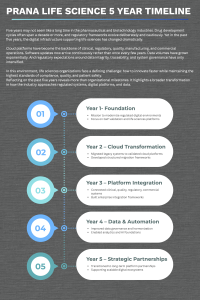
No modernization program succeeds if it paralyzes the business it is meant to improve. The organizations that navigate transformation most effectively do so by making a few deliberate structural choices.
Sequence for momentum, not just speed
Phased migration strategies that prioritize high-value, high-risk systems first — while building validation and change management infrastructure in parallel — consistently outperform attempts to transform everything simultaneously.
Use parallel operation strategically
Running legacy and modern systems in parallel during transition is not a failure of decisiveness — it is sound risk management. It creates space to validate new system performance before committing to decommission the old, and it builds organizational confidence in new platforms before full adoption.
Govern across functions, not just within IT
The most consequential decisions in a transformation program — which data to migrate, how to define system ownership, which interfaces to validate first — require judgment from quality, regulatory affairs, clinical operations, and commercial leadership, not just IT. Organizations that establish cross-functional governance structures early move faster with fewer reversals.
Invest in adoption
Technology capability that goes unused — or used incorrectly — does not deliver value. Change management and targeted training programs are not soft investments. They are the mechanism by which validated systems produce compliant outcomes in practice.
Modernization That Strengthens, Not Strains, Regulatory Trust
The most important insight for life sciences executives overseeing digital transformation is this: done well, modernization does not trade compliance for capability. It delivers both — simultaneously.
Organizations that approach data migration and system integration as governance initiatives, supported by technical execution, emerge from transformation with stronger data practices, cleaner audit trails, and more defensible compliance postures than they had before. They also emerge with the operational foundation needed to accelerate drug development, reduce quality costs, and make better decisions faster.
Done poorly, the same initiatives become a source of regulatory risk that can take years to remediate.
The difference is almost never technical. It is strategic.
Prana Life Sciences partners with pharmaceutical, biotechnology, and medical device organizations to design and execute data migration and system integration programs that are built for both performance and compliance. Our team brings deep experience across GxP validation, data integrity, and life sciences technology platforms — including Veeva, Salesforce, Medidata, SAP, and Oracle — to help organizations modernize with confidence.
If your organization is navigating a system modernization initiative and looking for a partner who understands both the strategic and regulatory dimensions, we would welcome the conversation.