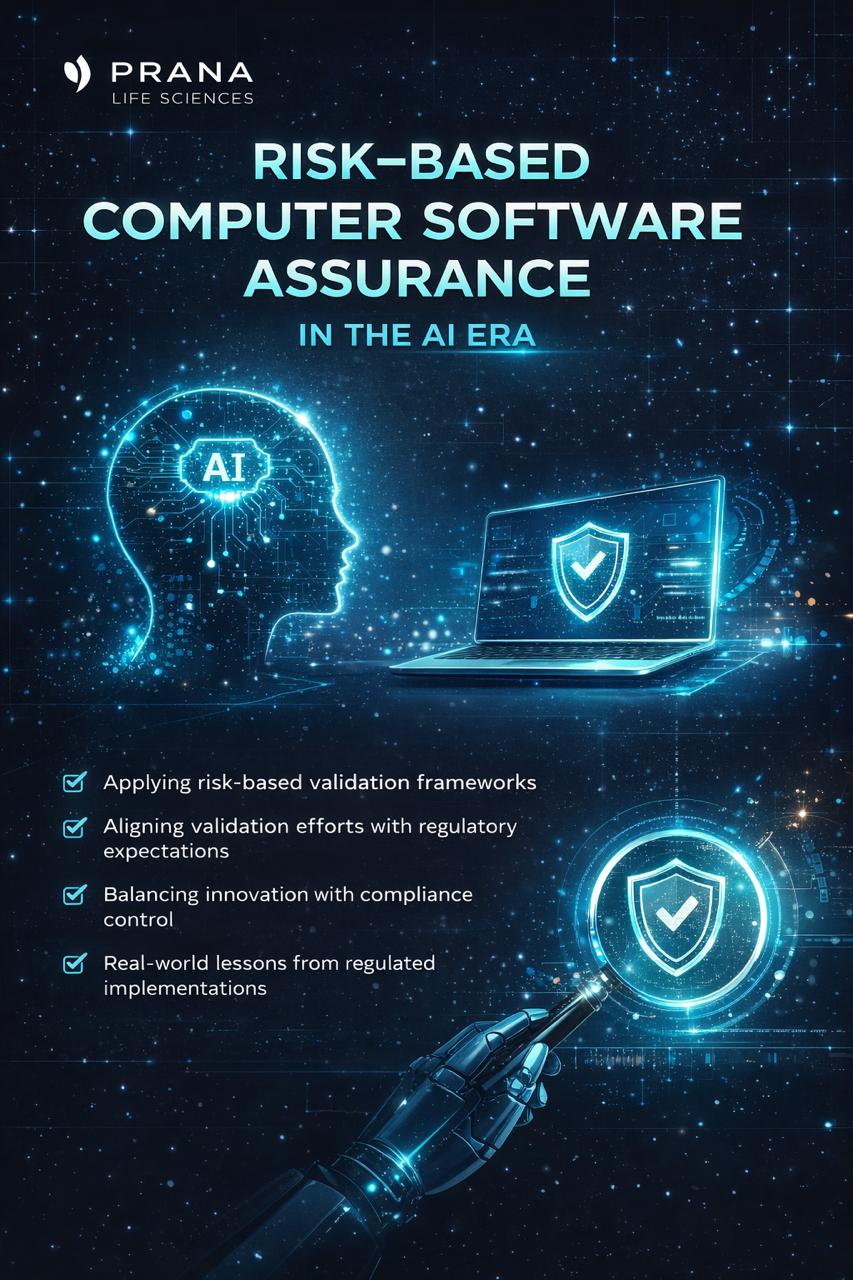
Risk-Based Computer Software Assurance in the AI Era
The life sciences industry is undergoing a fundamental shift in how software systems are validated and governed. As digital platforms become more complex and AI-driven capabilities increasingly influence regulated operations, traditional validation practices are being reexamined.
One of the most important developments in this transition is the growing adoption of Computer Software Assurance (CSA)—a modern, risk-based approach to validating software used in production and quality systems.
Introduced in recent regulatory guidance, CSA reflects a broader recognition that the historical model of Computer System Validation (CSV)—often characterized by exhaustive documentation and rigid testing protocols—may not always be the most effective way to ensure software reliability or compliance. Instead, CSA encourages organizations to focus validation activities on risk, critical functionality, and intended system use.
In the emerging AI-enabled technology landscape, this shift toward risk-based assurance is becoming increasingly relevant.
From CSV to CSA: A Shift in Philosophy
For decades, life sciences organizations have relied on Computer System Validation (CSV) as the standard framework for ensuring that computerized systems meet regulatory requirements. CSV processes traditionally emphasize detailed documentation, predefined validation protocols, and extensive testing.
While this approach has played an important role in maintaining compliance, it has also produced several unintended consequences:
- Excessive focus on documentation rather than system performance
- Validation activities that are time-consuming and resource-intensive
- Limited flexibility to accommodate modern agile development and cloud-based systems
Recognizing these challenges, regulators have begun encouraging a more pragmatic approach. The U.S. Food and Drug Administration’s guidance on Computer Software Assurance for Production and Quality System Software emphasizes that validation should be risk-based and evidence-focused, rather than documentation-heavy.
The core principle behind CSA is straightforward:
Validation effort should be proportional to the risk that software failure poses to patient safety, product quality, and data integrity.
This philosophy aligns validation practices more closely with how modern software systems are designed, deployed, and maintained.
Applying Risk-Based Validation Frameworks
At the heart of CSA is a structured evaluation of software risk. Instead of validating every function with the same level of rigor, organizations assess which features directly impact regulated processes and which pose minimal risk.
Risk-based frameworks typically consider several dimensions:
Intended Use of the System
Understanding how the software is used in production or quality processes is the starting point for determining validation scope.
Systems that directly influence product quality, patient safety, or regulatory reporting require greater scrutiny than systems used for administrative or informational purposes.
Process Impact
Validation teams evaluate how software functionality interacts with regulated workflows. For example, systems involved in batch release decisions, deviation management, or clinical data management may carry higher regulatory significance.
Detectability of Errors
If errors in a system can be easily detected through downstream controls, the validation risk may be lower. Conversely, systems where errors could propagate undetected require stronger assurance activities.
By structuring validation around these considerations, organizations can allocate resources more effectively and focus attention on the areas that matter most.
Aligning Validation Efforts with Regulatory Expectations
Risk-based assurance does not mean reducing rigor or relaxing compliance standards. On the contrary, CSA aims to strengthen compliance by ensuring that validation activities are aligned with regulatory priorities.
Regulatory authorities consistently emphasize several core expectations for computerized systems:
- Data integrity
- Traceability
- Change control
- Audit readiness
Risk-based validation supports these objectives by directing validation effort toward functions that have the greatest impact on regulated processes.
For example, automated workflows that influence product release decisions require robust verification and traceability. In contrast, low-risk system features—such as user interface preferences or non-regulated reporting dashboards—may require less extensive testing.
The CSA framework therefore promotes a more proportionate validation strategy, ensuring that testing depth reflects the level of regulatory risk.
Balancing Innovation with Compliance Control
The rise of artificial intelligence and advanced analytics introduces new challenges for validation teams. AI-driven systems may evolve dynamically, learn from new data, or generate outputs that cannot always be predicted using traditional deterministic testing methods.
These characteristics can make conventional validation approaches difficult to apply.
Risk-based assurance provides a practical framework for managing these complexities. Rather than attempting to validate every possible system behavior, organizations can focus on validating:
- The intended use of the AI system
- The quality and governance of training data
- Controls that detect and mitigate incorrect outputs
- Human oversight mechanisms
In this context, assurance shifts from validating individual outputs to validating the processes and controls surrounding the system.
This approach is consistent with broader regulatory expectations that emphasize risk management, governance, and accountability when deploying advanced technologies.
Real-World Lessons from Regulated Implementations
Organizations that have begun implementing CSA principles have observed several practical lessons.
Validation Should Focus on Critical Functions
Attempting to validate every feature with equal rigor often leads to inefficient validation programs. Identifying the system functions that directly impact regulated processes allows teams to concentrate validation effort where it has the greatest impact.
Documentation Should Support Evidence, Not Replace It
Historically, validation programs sometimes prioritized producing large volumes of documentation. CSA encourages organizations to focus instead on objective evidence that systems operate as intended.
This shift can reduce administrative burden while improving validation clarity.
Cross-Functional Collaboration Is Essential
Risk-based validation requires collaboration between quality assurance, IT, regulatory affairs, and business process owners. Understanding the true risk profile of a system depends on insights from multiple disciplines.
Organizations that foster cross-functional validation governance tend to implement CSA more effectively.
Continuous Monitoring Strengthens Assurance
Modern software systems evolve continuously. Validation strategies must therefore include mechanisms for ongoing monitoring, change management, and periodic reassessment of risk.
Continuous assurance helps ensure that validated systems remain under control throughout their lifecycle.
The Future of Software Assurance in Life Sciences
As life sciences organizations continue to adopt digital technologies, the importance of modern software assurance frameworks will only increase.
AI, cloud computing, and integrated enterprise platforms are transforming how regulated processes are managed. These technologies offer significant opportunities for innovation but also require thoughtful governance to ensure compliance and reliability.
Risk-based Computer Software Assurance provides a framework for navigating this landscape. By aligning validation activities with actual system risk, organizations can maintain strong compliance controls while enabling technological progress.
For senior executives responsible for digital transformation in regulated environments, the key takeaway is clear:
Effective compliance in the AI era will depend not only on validating systems, but on modernizing the way validation itself is performed.