Clinical studies in legacy CTMS oftentimes contain fields difficult to map into Veeva, and mapping these fields is a cumbersome activity that needs a lot of attention from business users – a challenge often due to time constraints. Additionally, multiple active studies mean that a mass study migration may pose a risk to business continuity. As a result, sponsors need to perform a thorough assessment, critical analysis, meticulous planning, and expert execution to overcome these challenges and ensure a smooth switch-off-switch-on study migration.
This article focuses on the subtleties of data migration strategy to ensure data quality, integrity, completeness, and business continuity during the study migration process.
1. Baseline for planning and strategy
Before planning a study migration, it is essential to perform an assessment of existing study data, system configurations, and usage of the legacy system. This assessment offers a good starting point, but organizational readiness and people’s perspectives are equally important facets that need to be addressed. Workshops, brainstorming sessions, ongoing communication, and training are some of the solutions to these challenges.
2. Source Data Remediation
The data issues should be addressed directly in the legacy CTMS, if possible. Once the data issues are addressed, a data extraction layer can be built to enable clean and complete study data extraction – a method recommended by data migration engineers as it reduces the burden of cleansing data in transit. However, data remediation is not always possible in legacy systems. In these cases, a collaboration between business and functional stakeholders becomes a critical aspect of strategic planning, which should not be overlooked. We recommend this high-effort, high-reward strategy.
3. Phased Approach
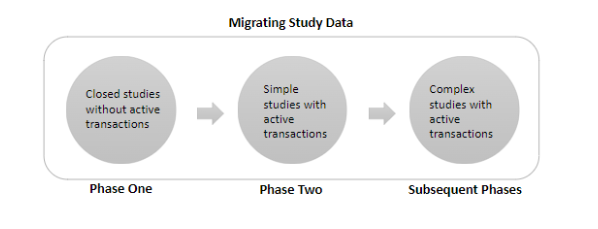
Migrating study data can be broken down into multiple phases. The first phase starts with closed studies without active transactions. You can take on active but simple studies in the second phase while leaving active and complex studies for the later phases.
This approach progressively prepares your team to take on future challenges associated with large and complex active studies that need to be migrated.
4. Parallel Processing
A critical time-consuming activity is the verification of migrated data in the test environment by validation engineers as well as functional stakeholders. The addition of manpower enables simultaneous verification for multiple studies. We have multiple case studies that demonstrate the benefits of such parallel processing. A critical factor is to use APIs and avoid using loader sheets, which are often complicated and error-prone. Veeva’s comprehensive API infrastructure addresses, and mitigates, these complications.
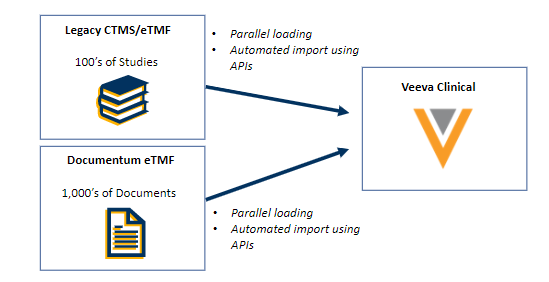
5. Automation
Data migration becomes cumbersome because of the sheer volume of manual activities needed during data mapping, extraction, cleansing, and transfer. The good news, however, is that most of these activities can be fully or partially automated using modern and smart tools. For example:
- Data mapping can be driven by automatic cataloging and profiling of legacy CTMS
- Data transformation rules in data mapping can be built using data remediation tools
- Data extraction files can be generated programmatically for each study
- Veeva Vault loading can be automated using Veeva’s API infrastructure
This process can be used easily and repetitively for multiple rounds of testing in sandbox environments. Without automation, repetitive testing can be a nightmare from a time as well as a cost standpoint. Automation also reduces the blackout period during migration in the production environment. This offers significant coverage to the business continuity requirements.
The migration of delta transactions is also a critical need for active studies. In the absence of automation, a delta migration has the potential to become a full-fledged project on its own. The adoption of automation offers a significant reduction in time, effort, and cost required for delta migration should the need arise.
6. Optimizing Validation Efforts
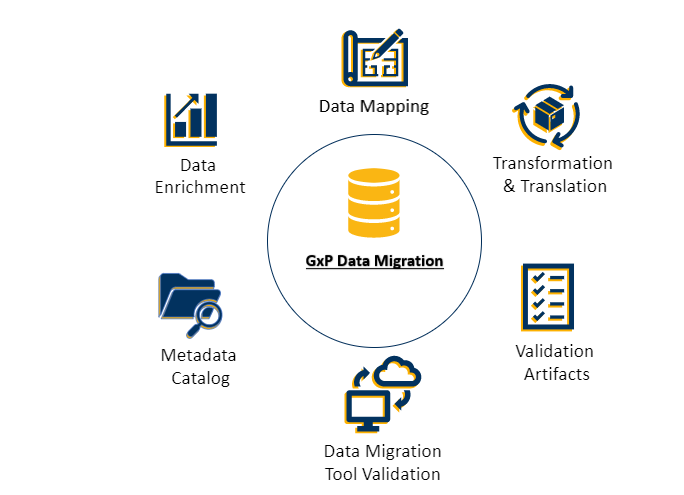
GxP Validation of data migration can become a bottleneck due to the requirements, such as:
- Qualification of tools
- Verification of extracted data
- Verification of migrated data
A risk-based approach, automation, and the use of digital validation platforms and pre-qualified tools are certain ways to optimize validation efforts.
Note: The suggestions in this article are based on several successful implementations by the clinical data migration specialists at Prana Life Sciences.
Please note that Veeva Vault is a proprietary trademark of Veeva Systems. Please visit Veeva’s site for more details: www.veeva.com
You may also be interested in our other blog articles:
- Reducing Submission Time with Veeva Vault RIM – Prana Life Sciences LLC (prana4life.com)
- Using Veeva Vault Training for GxP and Non-GxP Content – Prana Life Sciences LLC (prana4life.com)
- Veeva Vault Implementation Groundwork – Prana Life Sciences LLC (prana4life.com)
For more information, please Contact Us.