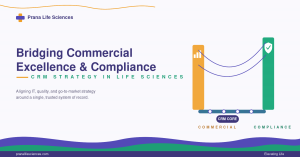
Rethinking Quality in Life Sciences: Why AI Is the New Compliance Partne World Quality Week 2025 Theme: Quality — Think Differently
By Prana Life Sciences
In life sciences, quality is not just a function — it is the foundation on which trust, safety, and innovation are built. Yet many organizations today continue to treat quality and compliance as a barrier: an obligation, a slow-moving checkpoint, or a cost center that limits speed.
This World Quality Week, with the global theme “Quality: Think Differently,” we are invited to rethink this mindset. Quality is not an anchor holding organizations back. When approached intelligently — and supported by new capabilities like AI — quality becomes a strategic accelerant.
At Prana Life Sciences, we believe the industry has reached a turning point. AI is no longer an experimental add-on. It is becoming the new compliance partner — enabling organizations to strengthen alignment, improve performance, and embed quality deeper into every decision.
1. The Myth of “Compliance vs. Innovation”
For decades, life sciences teams have been conditioned to think of compliance as the opposite of innovation. The fear of audits, inspection readiness, regulatory scrutiny, and validation overhead often leads to overprocessing, over-documentation, and slowed change.
But the myth is cracking.
Modern regulatory agencies — including the FDA, EMA, MHRA — are all encouraging innovation as long as quality and risk controls are preserved. Digital validation, automated testing, and AI-driven monitoring are no longer futuristic; they are becoming mainstream best practices.
When organizations think differently about quality, a new picture emerges:
• Compliance does not slow innovation — manual, outdated processes do.
• Quality does not require more documents — it requires better evidence.
• Risk avoidance does not require rigidity — it requires better intelligence.
AI provides that intelligence.
2. AI-Powered Quality Assurance in GxP Systems
GxP environments — R&D, clinical, manufacturing, lab systems, pharmacovigilance, and commercial — are built on consistency, reliability, traceability, and validation. But the traditional approach is heavy, reactive, and human-dependent.
AI transforms GxP assurance in 3 key ways:
✓ Continuous Monitoring Instead of Periodic Review
AI systems can continuously evaluate system logs, usage patterns, configuration changes, data integrity indicators, and validation controls — long before a human review cycle.
✓ Automated Audit Trails & Evidence Generation
Rather than manually compiling screenshots, test evidence, or validation documentation, AI can create structured, complete, and formatted validation evidence instantly.
✓ Data-Driven Decision Support for Quality Teams
Quality managers can use AI dashboards to identify early quality risks, gaps, or anomalies rather than discovering them during audits or post-release.
AI doesn’t replace quality teams — it amplifies their intelligence and speed.
3. Intelligent Risk Detection and Anomaly Tracking in Validation
Validation today still relies heavily on manual review. A single human oversight can introduce system risks that affect compliance, data integrity, or patient safety.
AI introduces a fundamentally different capability: proactive risk intelligence.
AI can detect risks such as:
• Unexpected system behavior
• Configuration drifts
• Data integrity deviations
• Security anomalies
• Unapproved changes
• Process inefficiencies
• Missing validation controls
AI also helps by:
• Ranking risks by severity
• Providing contextual explanations
• Suggesting remediation steps
• Tracking recurring patterns
• Predicting future failure points
This “intelligent validation” shifts organizations from reactive quality predictive quality — the very definition of “thinking differently.”
4. Aligning AI With Regulatory and Strategic Quality Goals
World Quality Week emphasizes Alignment, Performance, and People — and AI bridges all three.
Alignment:
AI allows quality to fully align with an organization’s strategic goals by providing real-time clarity on compliance readiness, system status, validation health, and operational risk.
Quality becomes integrated into strategy — not a post-hoc checkpoint.
Performance:
AI improves quality performance by detecting risks earlier, reducing cycle times, accelerating validation, and eliminating manual defects.
Organizations see faster system releases, fewer deviations, and more consistent outcomes.
People:
AI empowers teams — it doesn’t replace them.
By removing manual, repetitive tasks, quality professionals can focus on higher-value activities:
• Risk assessment
• Audit readiness
• Continuous improvement
• Strategic quality design
This is how organizations cultivate the agile, resilient, forward-thinking quality culture that World Quality Week calls for.
5. Real-World Use Case: How Prana’s AI Tools Help Embed Quality from the Start
Prana Life Sciences has developed AI-powered tools that address the biggest challenges in validation, quality assurance, and life sciences system implementations.
Example: AI-Driven Validation Accelerator
Our AI validation engine can:
• Analyze system configurations
• Generate test scripts
• Review evidence
• Auto-detect anomalies
• Flag high-risk functions
• Suggest validation coverage improvements
• Provide audit-ready documentation
This ensures that quality is embedded from the very beginning — not bolted on at the end.
The Result?
Organizations achieve:
• 50–70% faster validation cycles
• Reduced risk of compliance gaps
• Automated, consistent audit trails
• Stronger alignment between IT, QA, and business teams
• Continuous inspection readiness
• Lower cost of quality
• Higher team morale and less validation fatigue
This is what “thinking differently” looks like — quality as a strategic enabler powered by AI.
The Future of Quality in Life Sciences
As we celebrate World Quality Week, we are reminded that quality is not static. It evolves with the world around us. The life sciences industry is embracing digital ecosystems, rapid innovation cycles, and data-driven decision making — and quality must evolve alongside them.
AI is not replacing quality.
It is transforming quality into something faster, smarter, more proactive, and more aligned with organizational purpose.
At Prana Life Sciences, we believe the companies that thrive will be those that:
• Treat AI as a compliance partner
• Embed quality into every stage of the lifecycle
• Empower their teams with automation, intelligence, and insight
• Build resilient quality cultures
• Think differently about how quality drives performance
Call to Action
If your organization is looking to modernize validation, strengthen GxP compliance, or explore AI-powered quality tools, Prana Life Sciences can help you build a future-ready quality ecosystem.
Let’s explore how to bring AI-driven quality into your operations.